
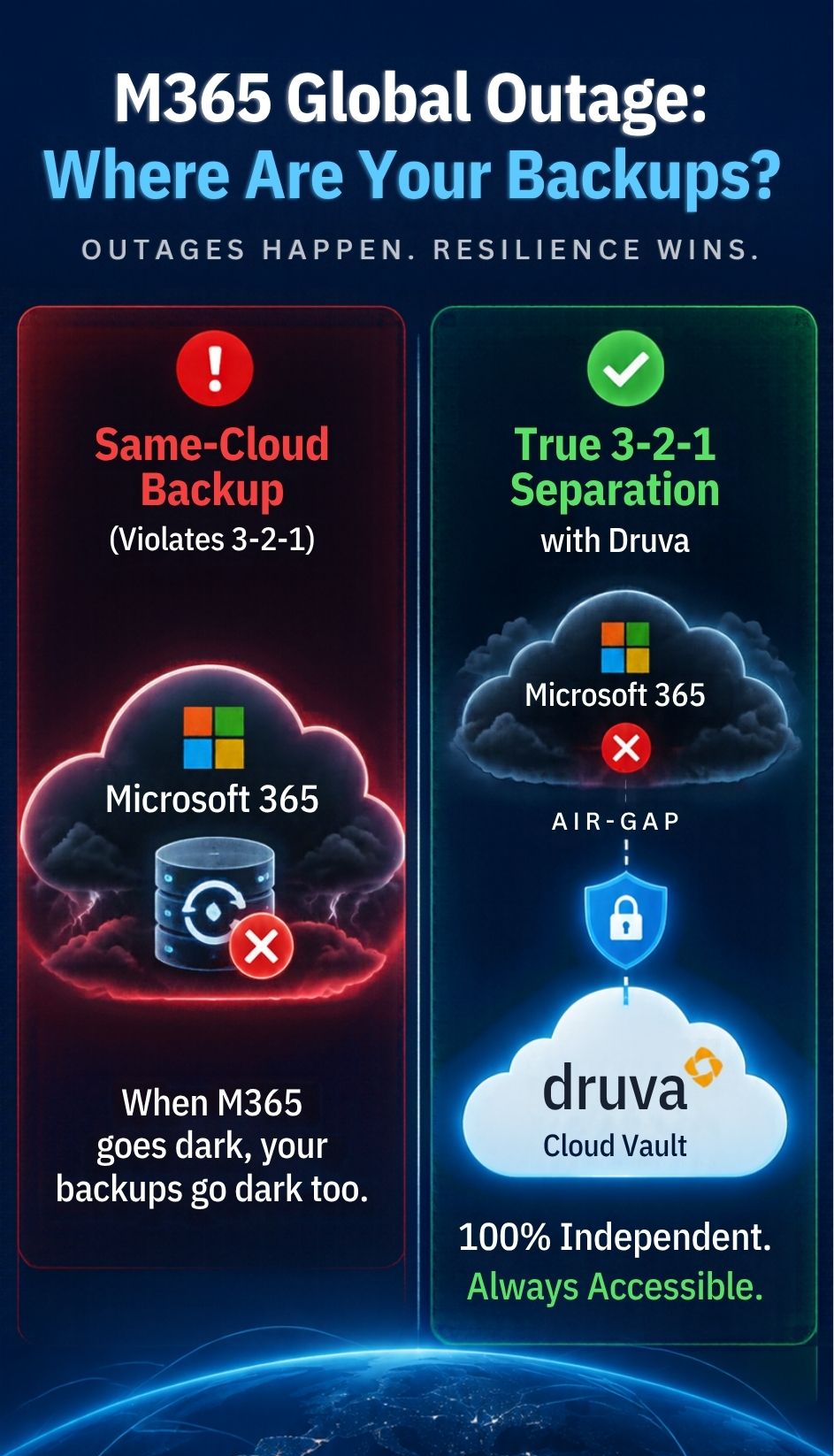
The Wake-Up Call: When Productivity—and AI—Grind to a Halt
On November 12, 2026, a massive global outage struck Microsoft 365, disrupting core enterprise services including Exchange Online (Outlook), Microsoft Teams, SharePoint, and Defender XDR. Within hours, tens of thousands of outage reports flooded tracking platforms across North America, Europe, and Asia-Pacific. Crucially, the disruption didn't just stop employees from sending emails or joining meetings—it also severed API connections for enterprise AI tools like Microsoft Copilot, OpenAI, and Anthropic integrations that rely on live M365 data.
While Microsoft engineers worked to reroute traffic and restore degraded servers, the incident exposed a critical architectural blind spot that many organizations overlook until it is too late: relying on the same cloud vendor for both production workloads and data backups.
The Hidden Flaw of "Same-Cloud" M365 Backup
Many businesses assume that simply having a backup tool for Microsoft 365 checks the compliance and disaster recovery box. However, a growing number of M365 backup solutions—including native offerings and third-party tools hosted on Azure—store your backup snapshots inside Microsoft’s own cloud infrastructure.
When an outage like yesterday’s occurs, organizations utilizing same-cloud backup architectures face a severe double-blind spot:
- Production Access is Lost: Employees cannot access live emails, Teams chats, or SharePoint documents.
- Backup Access is Also Lost: Because the backup repository sits on the exact same underlying cloud infrastructure, administrators cannot log in, browse, or export critical files during the outage.
If your production environment and your backup environment share the same point of failure, you do not have a disaster recovery strategy—you simply have two copies of data locked behind the same broken door.
Why the 3-2-1 Backup Rule Demands Cloud Independence
At Cloud Ocean Tech, we consistently emphasize the foundational gold standard of data protection: the 3-2-1 Backup Rule:
- 3 copies of your data (1 primary, 2 backups)
- 2 different storage media or platforms
- 1 copy stored off-site—completely isolated from the primary environment
In the era of SaaS, "off-site" no longer means shipping magnetic tapes to a physical vault; it means cross-cloud architectural independence. Your backup data must live in a separate security domain, managed by an independent provider, on a completely separate cloud infrastructure.
How Druva Delivers True Resilience for Microsoft 365
To genuinely uphold the 3-2-1 rule for Microsoft 365, Druva provides an industry-leading, 100% SaaS data resilience platform built on a fundamentally different architecture:
- Complete Cloud Separation: Druva runs entirely on AWS, completely decoupled from Microsoft’s infrastructure. When Microsoft 365 experiences a regional or global outage, Druva remains 100% operational.
- Uninterrupted Data Access & E-Discovery: Even while Outlook or SharePoint is offline, IT teams using Druva can still search, access, and export critical emails or files to keep urgent business operations moving.
- Air-Gapped & Immutable by Design: Beyond outages, Druva protects your M365 data against ransomware and accidental or malicious deletion (including rogue AI agent actions) with immutable, encrypted backups that cannot be altered or wiped.
- Zero Hardware or Maintenance: As a pure SaaS solution, there are no servers, storage pools, or Azure instances for your IT team to patch or manage.
Is Your M365 Data Truly Protected?
Cloud outages are an inevitable reality of modern IT. When the next disruption hits, your business continuity shouldn't depend on a single vendor's status page.
If you are unsure where your current Microsoft 365 backups are physically hosted—or if you want to transition to a truly independent 3-2-1 backup architecture—Cloud Ocean Tech is here to help.
Contact our Cloud Resilience Team today for a complimentary M365 Backup Architecture Assessment and discover how Druva keeps your business running, no matter what happens in the cloud.


